30-Day Declutter Calendar: One Task a Day, Every Room Covered
June Callow 6 min read

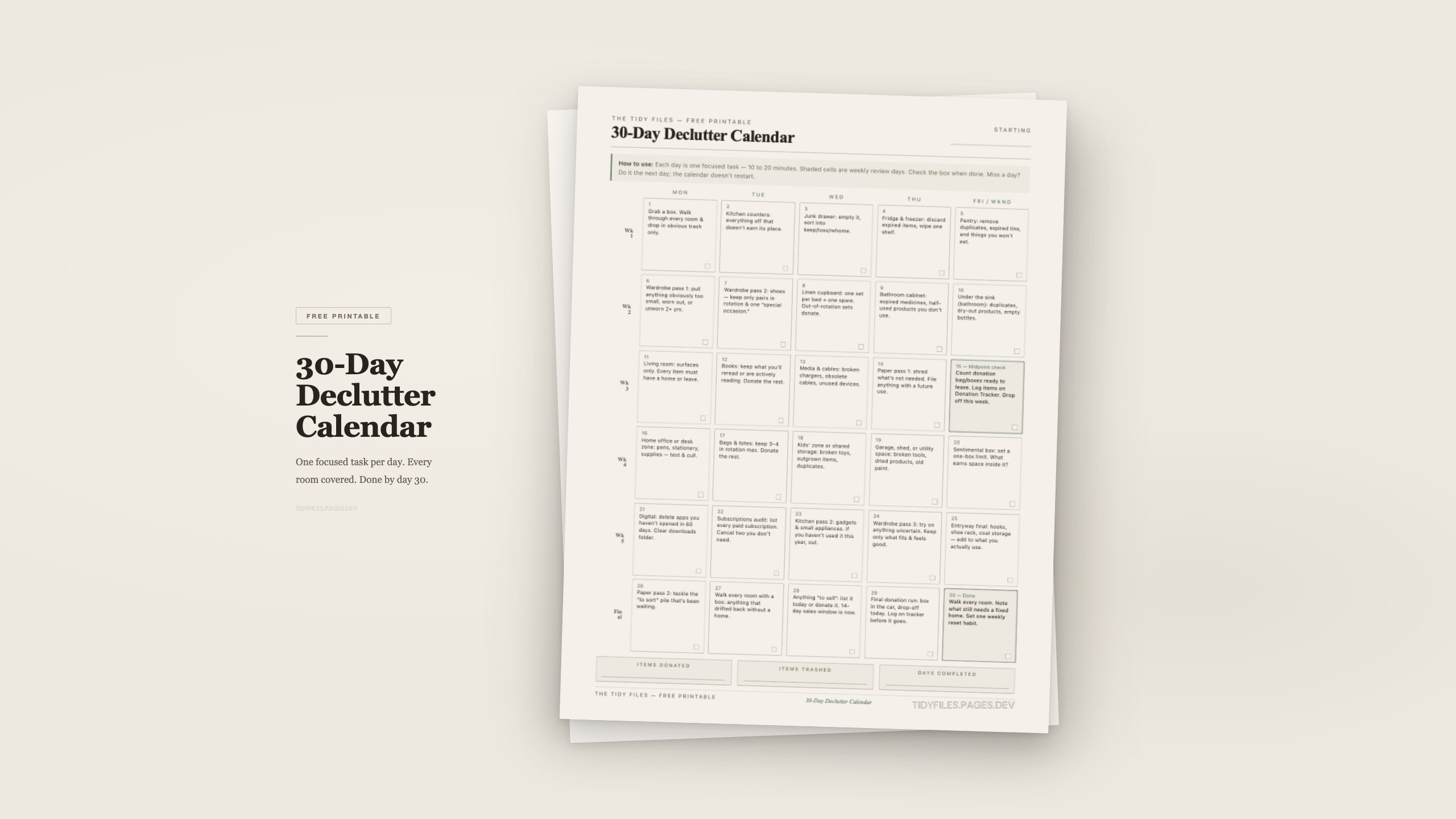
A 30-day declutter calendar breaks what is usually a large, vague project — “declutter the house” — into 30 specific tasks, each taking 10 to 20 minutes. One task per day. Every major zone of the home covered by day 30. The sessions are short enough to fit into a weekday evening; the accumulated progress is substantial.
This approach works because it removes the two biggest barriers to starting a declutter: deciding what to tackle and knowing when to stop. The calendar decides both for you.
Download the free calendar: 30-Day Declutter Calendar (PDF) — one page, US Letter, no email required.
Why short daily sessions outperform weekend marathons
The instinct when facing a cluttered house is to block out a full Saturday and “just deal with it.” This works occasionally — when you have genuine energy, no interruptions, and the emotional bandwidth for difficult decisions. More often, the marathon session runs three hours, produces a pile of items “to deal with later,” and ends in exhaustion before the house is actually done.
Daily 15-minute sessions compound differently. Each session has a clear start (a specific task) and a clear end (the task is done). Decision fatigue doesn’t accumulate the same way — you’re making 10 decisions about 10 items, not 200 decisions about 200 items in a row. And because you’re returning to the project the next day instead of treating it as a one-off event, the habit of regular decluttering builds alongside the physical progress.
The calendar is structured with this in mind. Weeks 1 and 2 cover the highest-friction zones: kitchen, wardrobe, bathroom, linen storage. Week 3 addresses living areas and paper. Week 4 handles the specific categories that usually get left out — digital clutter, subscriptions, accessories. The final days are designed as pass-throughs to catch drift and complete the donation run.
How to use the calendar
Print it and post it. The same logic applies here as with the Sunday Reset checklist: visible beats digital for habit compliance. Post it somewhere you’ll see it in the evening — kitchen, office, bathroom mirror.
Do the tasks in order. The sequence is deliberate: earlier tasks build momentum with quick wins (clearing counters, dealing with obvious trash), while later tasks require more judgment (sentimental items, the “might be worth something” pile). Reversing the order front-loads the hard decisions and often stalls the whole effort.
Check the box when done. The physical act of checking a box is not trivial — it provides a completion signal that your brain responds to. Don’t underestimate it.
Miss a day? Don’t restart. Missing a day is not a failure state. Do the previous day’s task the next day and continue. The calendar doesn’t reset; it just continues. A 30-day calendar completed in 35 days is still a completed calendar.
Day 15 is a midpoint checkpoint. The shaded day 15 task is intentionally different: count your donation bags, log items on a tracker, and schedule the actual drop-off. A donation box that sits in your hallway for three weeks is still clutter. Day 15 gets it out the door.
Zone-by-zone overview
Week 1 (Days 1–5): Kitchen Starting with the kitchen is deliberate. It’s the most-used room in most homes and has the most visible impact when it’s cleared. Day 1 is a pure trash pass — no decisions, just discarding obvious waste. Days 2 through 5 move through counters, the junk drawer, fridge and freezer, and pantry.
Week 2 (Days 6–10): Wardrobe and bathroom The wardrobe gets two passes: Day 6 for clothing you clearly don’t want, Day 7 for shoes. A single pass rarely catches everything — the second pass, done with fresh eyes, almost always finds more. Days 8 through 10 cover linen storage, the bathroom cabinet, and under the sink.
Week 3 (Days 11–15): Living areas, media, and paper The living room surface pass, books, cables and devices, and the first paper pass. Day 15 is the midpoint checkpoint — donation run scheduled, tracker logged.
Week 4 (Days 16–20): Office, accessories, and the difficult categories Home office, bags and totes, kids’ zone (or shared storage), garage or utility space, and the sentimental box. The sentimental box task on Day 20 is deliberately placed late in the process — by this point you’ve built momentum and made enough easy decisions that the harder ones feel more manageable.
Week 5 (Days 21–25): Digital, subscriptions, and second passes Digital clutter (apps and downloads), subscription audit, kitchen pass 2 for gadgets and appliances, wardrobe pass 3 for uncertain items, and the entryway final. The digital tasks matter: unused apps and redundant files don’t take physical space, but subscription costs are a real ongoing drain.
Final stretch (Days 26–30): Catch-up and completion Paper pass 2, a whole-house drift check, the “to sell” deadline, the final donation drop-off, and Day 30 — a walk through every room to document what still needs a permanent home.
What to do with the donation pile
Log everything before it leaves the house. Charitable donations of goods are deductible in the US when itemized, but the documentation burden falls on you — the charity only provides a receipt confirming a donation was made, not an itemized list. Your own log serves as the primary record.
The Reset Kit on our products page includes a full Donation Tracker with a tax documentation note and 18 rows for logging date, organization, description, quantity, and estimated fair market value. For a smaller session, a piece of notebook paper works — what matters is that the log exists before the box leaves.
For the difficult decisions that come up during any 30-day run, the Donation Decision Card provides the keep/donate/toss framework item by item. For a whole-house method that structures decluttering by type of decision rather than by room, the 5-Day Clutter Shakedown is the companion approach.
Common questions
How long does each task actually take?
10 to 20 minutes for most tasks. A few — the junk drawer, the sentimental box — can take longer if you're in a decision-heavy zone. The calendar is designed so that 15 minutes a day is enough to complete it in 30 days. If a task runs long, stop at 20 minutes and pick it up the next day rather than skipping the following day's task.
What if I don't have a garage or linen cupboard?
Skip that day's task and use the time to do a second pass on the nearest equivalent — extra clothing storage, a coat cupboard, under the bed. The calendar is a structure, not a rigid script. Adapt zones to match your actual home.
Can I do multiple tasks in one day to finish faster?
Yes, but with a caveat: decluttering decision quality drops sharply after 30 to 45 minutes in a single session. If you double up, take a real break (15+ minutes, different room) between tasks. Don't try to do five days in one sitting — you'll hit decision fatigue and start keeping things you'd otherwise let go.
What's the point of the stats at the bottom of the calendar?
Tracking items donated and trashed over 30 days creates a concrete picture of what left your home. That number — even a rough estimate — is motivating in a way that a feeling of vague progress isn't. Most people who track it are surprised by how much it adds up.
Download: 30-Day Declutter Calendar (PDF, free)
Prefer a shorter page with just the quick answer, what’s inside, and the download button — no full guide? Get it on the 30-Day Declutter Calendar download page.