Donation Decision Card: Keep, Donate, or Toss — Six Questions
June Callow 6 min read

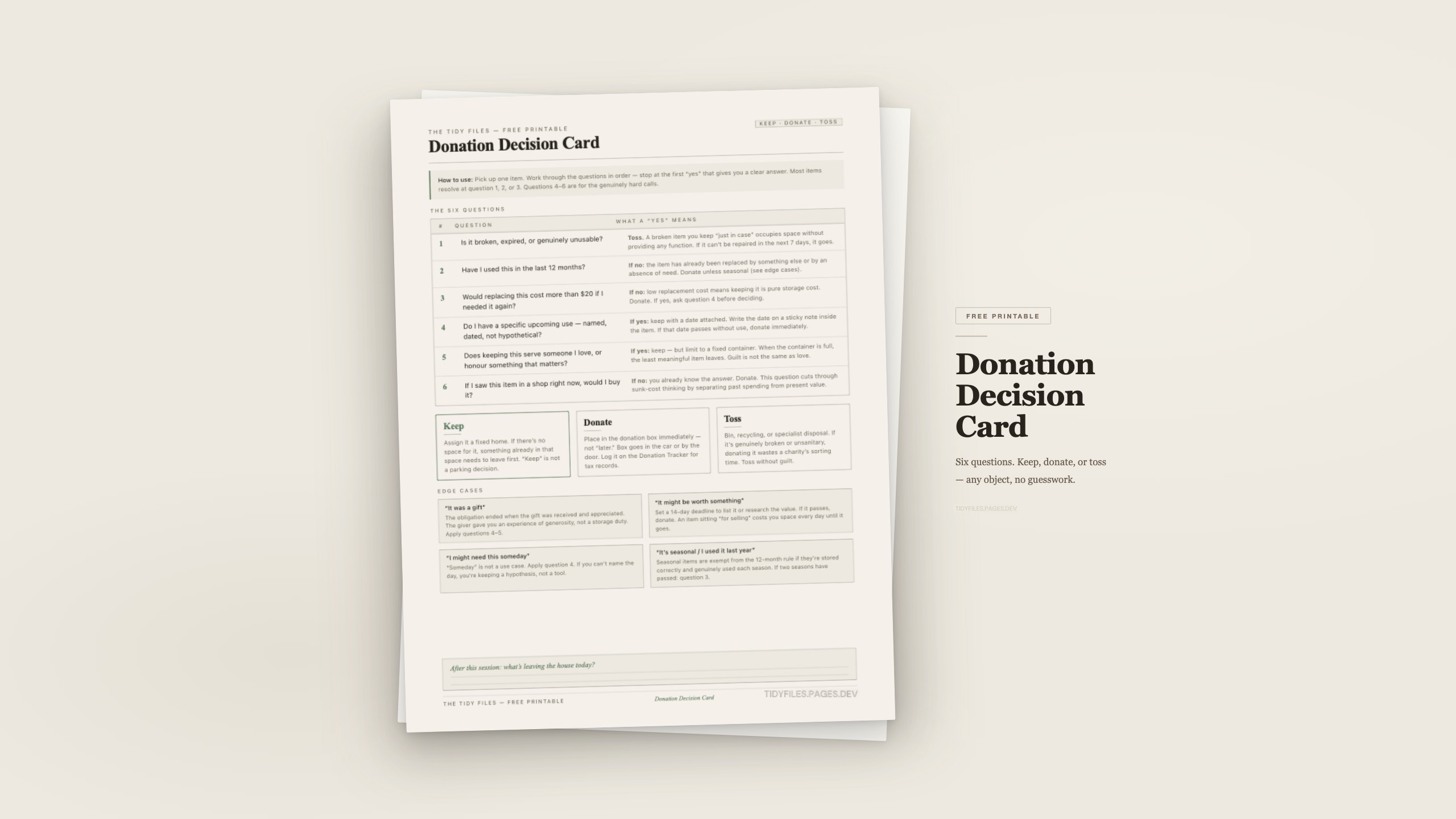
The hardest part of decluttering is not the physical work — it’s the decision fatigue. You pick up an item, hold it, feel vaguely guilty, put it back. Multiply that by two hundred items in a single bedroom and you understand why most declutter sessions end with a slightly tidier room and a growing pile of “I’ll decide later.”
A keep/donate/toss decision framework cuts through this by reducing every item to the same six questions, in the same order, until one gives you a clear answer. Most items resolve at question one, two, or three. The framework exists for the six or seven out of ten that are genuinely difficult — and it’s the tool that underlies every method in our decluttering methods comparison, regardless of which one you’re following.
Download the free card: Donation Decision Card (PDF) — one page, US Letter, no email required.
How the decision framework works
The card runs six questions in escalating order of difficulty. You stop at the first question that gives you a clear answer. Working through all six is reserved for items where the first five didn’t resolve it — which is rare.
Question 1: Is it broken, expired, or genuinely unusable? The easiest category. Expired medication, a broken lamp with no repair plan, a phone charger for a device you no longer own. These go without a decision — they’re already decided; the only remaining task is physically removing them. The friction here isn’t cognitive; it’s the five-second act of putting the item in the bin.
Question 2: Have I used this in the last 12 months? Twelve months covers every season and most use-case cycles. If you haven’t needed it in a full year, the item has already been replaced by something else — or the need for it has passed. The seasonal exception (a snow shovel, a specific holiday decoration) is handled in the edge cases on the card.
Question 3: Would replacing this cost more than $20 if I needed it again? This is the pragmatic filter. Low-cost items carry no replacement risk — the cost of keeping them (space, visual noise, mental load) exceeds the cost of replacing them if needed. Items that pass this question move to question 4 for further evaluation.
Questions 4, 5, and 6 address the genuinely hard cases: items with a specific upcoming use, items with sentimental weight, and items you’d choose not to buy again if you saw them in a shop. Question 6 — the shop test — is particularly effective for sunk-cost items. If you wouldn’t pick it up off a shelf today, you’re keeping it because of money already spent, not because of value it still provides.
The three outcomes
Keep means assigned a fixed home immediately, not “set aside to deal with later.” If there’s no obvious home for it, something already in that location needs to leave first. Keeping an item without a fixed home is just relocating it.
Donate means into the donation box immediately — not a “donate pile” that lives in the corner for three months. The card recommends logging donated items on a Donation Tracker for potential tax documentation before the box leaves your house. The Reset Kit includes a full Donation Tracker with tax note as part of its 10-page set.
Toss applies to items that are genuinely broken, unsanitary, or too worn to be useful to anyone. Donating these wastes charity volunteers’ sorting time — they’ll throw it away on your behalf. Toss without guilt.
The edge cases
The four edge cases on the card address the most common stall points in declutter sessions:
“It was a gift.” The obligation ended when you received and appreciated the gift. The giver gave you an experience of generosity, not a lifelong storage responsibility. Apply questions 4 and 5 — if neither resolves it, donate.
“It might be worth something.” Set a 14-day window to list it or research the value. If that window passes without action, donate. An item sitting “for selling” costs you real space every day until it moves. Most items people believe are valuable are not valuable enough to sell.
“I might need this someday.” “Someday” without a specific scenario is not a use case. Apply question 4: if you can’t name the day or the purpose, you’re keeping a hypothesis. Donate.
“It’s seasonal, I used it last year.” Seasonal items are legitimately exempt from the 12-month rule — a paddleboard used every summer, a pasta machine used every Christmas. But “used last year” as a reason to keep something you haven’t used in two summers is seasonal logic stretched past its breaking point. Apply question 3 if two seasons have passed without use.
Using the card in a real session
Print the card and tape it to the wall near your declutter zone — wherever you’re working. Pick up one item. Start at question 1. Stop at the first clear answer. Put the item in the appropriate pile (keep box, donate box, toss bag).
The card works best when you’re moving quickly. Slow deliberation on each item signals question 5 territory — a sentimental item that deserves a moment, not a time limit. Everything else should resolve in under 30 seconds.
For a room-by-room approach to using these questions across your whole house, the 5-Day Clutter Shakedown guide pairs naturally with this card — the Shakedown method sequences decluttering by decision difficulty in the same way this framework does. The paper clutter system post covers the specific case of sorting papers, files, and documents, which have their own decision architecture.
If you’re decluttering ahead of a move or major life transition, the donation card is your in-session tool; a full tracker for the outcome is on the products page.
Common questions
What's the difference between donate and toss?
Donate is for items that still function and could be useful to someone else. Toss is for items that are broken, expired, heavily worn, or unsanitary — things a charity worker would throw away anyway. Donating non-functional items shifts the disposal burden to the charity, which wastes their sorting time. Toss without guilt when the item genuinely can't help anyone.
How do I handle guilt about getting rid of things I spent money on?
The money is already spent whether the item stays or goes — keeping it doesn't recover the cost. Question 6 on the card addresses this directly: if you wouldn't buy it again at full price today, you're keeping a reminder of a past decision, not an item of present value. Donate it and redirect the space.
Should I sort items before applying the framework, or go room by room?
Room by room is almost always faster and less overwhelming. Sorting by category first (all clothing from the whole house, KonMari-style) is effective if you can sustain it — but it requires a large uninterrupted block of time. The decision card works for either approach: pick up one item, apply the questions, move to the next.
What counts as 'genuinely used' in the 12-month question?
Used means you removed it from storage, performed an action with it, and it served its function. Worn once counts. Looked at it and put it back does not count. When in doubt, imagine you're explaining the use to someone who will judge whether it was real — if you're qualifying the answer, it probably wasn't genuinely used.
Download: Donation Decision Card (PDF, free)
Prefer a shorter page with just the quick answer, what’s inside, and the download button — no full guide? Get it on the Keep, Donate, or Toss Decision Card download page.